CRESO Project Comes Together in Nice, France
We keep crossing borders with science
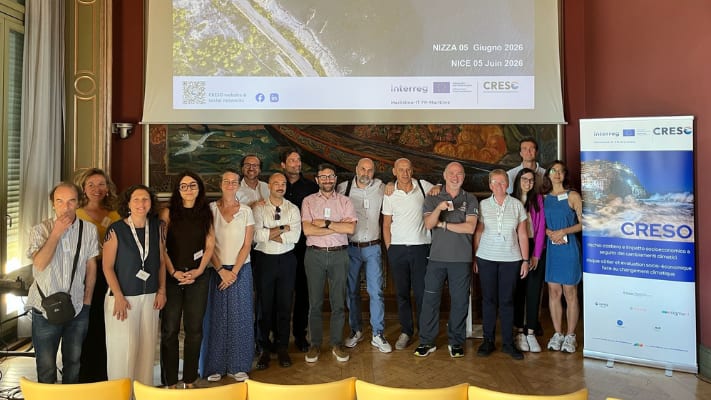
The Interreg Marittimo CRESO project team gathered in Nice, France to share the initial results of the project on June 5, 2026. Although it is hard to believe that it has already been a year since we started this journey, it was a proud moment to see how far we have come.
The event, held at the Nice Côte d'Azur Metropolitan Area at the Mediterranean University Centre, was a significant milestone: not only an opportunity for all the partners to update one another, but also a meaningful moment to share important insights with stakeholders from across the region. start to the event. As the leading partner of CRESO, MeteOcean opened the presentation session with Prof. Giovanni Besio's introduction to the project for the broad audience.
The CRESO project addresses one of the most pressing challenges that the Mediterranean coastlines are facing: the comprehensive assessment of coastal hazard risk in densely populated and economically stragetic coastal areas. The project aims to provide a better understanding of coastal hazards and their impacts and to develop useful tools and methodologies in the scope of three work packages with the following objectives:
- Providing knowledge and projections of coastal hazards in the context of climate change
- Identifying the coastal areas at risk through vulnerability assessments
- Constructing an action plan for the identified coastal areas which are vulnerable to investigated coastal hazards
MeteOcean's Filippo Giaroli (PhD) described the generation process of the dataset of coastal forcings, which is constructed to be utilized for the analyzes of current and future risks. It is a high-resolution historical data spanning over 45 years, from 1979 to 2023, alongside a dataset based on future climate projections for the Mediterranean region up to 2100. He concluded the presentation by sharing insights into the coastal flooding analyzes performed by utilizing these datasets for the pilot sites of the project and the initial results of these analyses.
Filippo D’Ascola and Paolo Gyssels from ISPRA presented a scientific approach which aims at better characterizing recent coastal evolution and the effects of human interventions at coastal scale. Their work centers on an innovative cross-border geodatabase designed to integrate existing data with new indicators, providing a robust framework for interpreting observed coastal transformations.
Cèline Trmal and Marion Labainville from Cerema introduced their newly developed scientific method for assessing the territorial impacts of coastal risks across the Interreg area and at the pilot sites. Combining physical exposure, socio-economic factors, and environmental dimensions, the method offers a more comprehensive understanding of the vulnerability of coastal areas to marine hazards.
Giuseppe Saibante from Sigma NL highlighted the need to assess the impacts of climate change over coastal zones from a human well-being perspective. The core objective of their work is to improve traditional approaches which are limited to material damage Their proposed method integrates the use and non-use values associated with coastlines, ecosystem services, and social practices. Their proposed method combines a set of physical and socio-economic indicators, spatial analyzes supported by GIS, and a bottom-up approach built on surveys, interviews, and stakeholder consultations.
Alessio Satta from MEDSEA outlined a methodological framework for moving from climate risk analyzes to operational decision-making. The framework bridges scientific knowledge and practical action, enabling coastal risk assessments to inform solid adaptation decisions for vulnerable coastal zones.
Pauline Santelli from the Corsican Urban Planning and Energy Agency (AUE) presented their work focusing on the Ajaccio site. The presentation revealed an initial socio-economic territorial assessment and laid out the groundwork for integrating analyzed risks into future planning tools. The initial results of their study show that Ajaccio faces high exposure to climate hazards, and the site has significant social, economic, and cultural vulnerabilities. Additionally, the presentation highlighted the vulnerability of cultural heritage sites and a notable gap in the knowledge regarding the potential damage to these assets.
The CRESO event in Nice was a remarkable opportunity for sharing knowledge and initial results with both the project team and an audience, including stakeholders. It was a powerful reminder of how much can be achieved when expertise from different fields comes together, and of how essential it is to approach complex problems from multiple perspectives in order to build solutions that are truly for everyone.